


Nude Figure on Patterned Damask
Nude Figure on Patterned Damask
Couldn't load pickup availability
About our restored prints
About our restored prints
Expertly restored: tears and stains are fixed, original clarity and depth of color are thoughtfully revived.
- Printed on museum-quality fine art paper
- Archival inks for long-lasting color
- Professionally color-calibrated
- Most framed prints ship unassembled for safety. Assembly is simple.
Shipping & Return Policy
Shipping & Return Policy
Classic Prints/Framed prints: 1-2 weeks
Frames & Decor: 2-3 weeks
Custom Frames: 2-3 weeks
Returns within 2 weeks.
Custom Framed prints are hand assembled and cannot be returned.
See policies in the footer
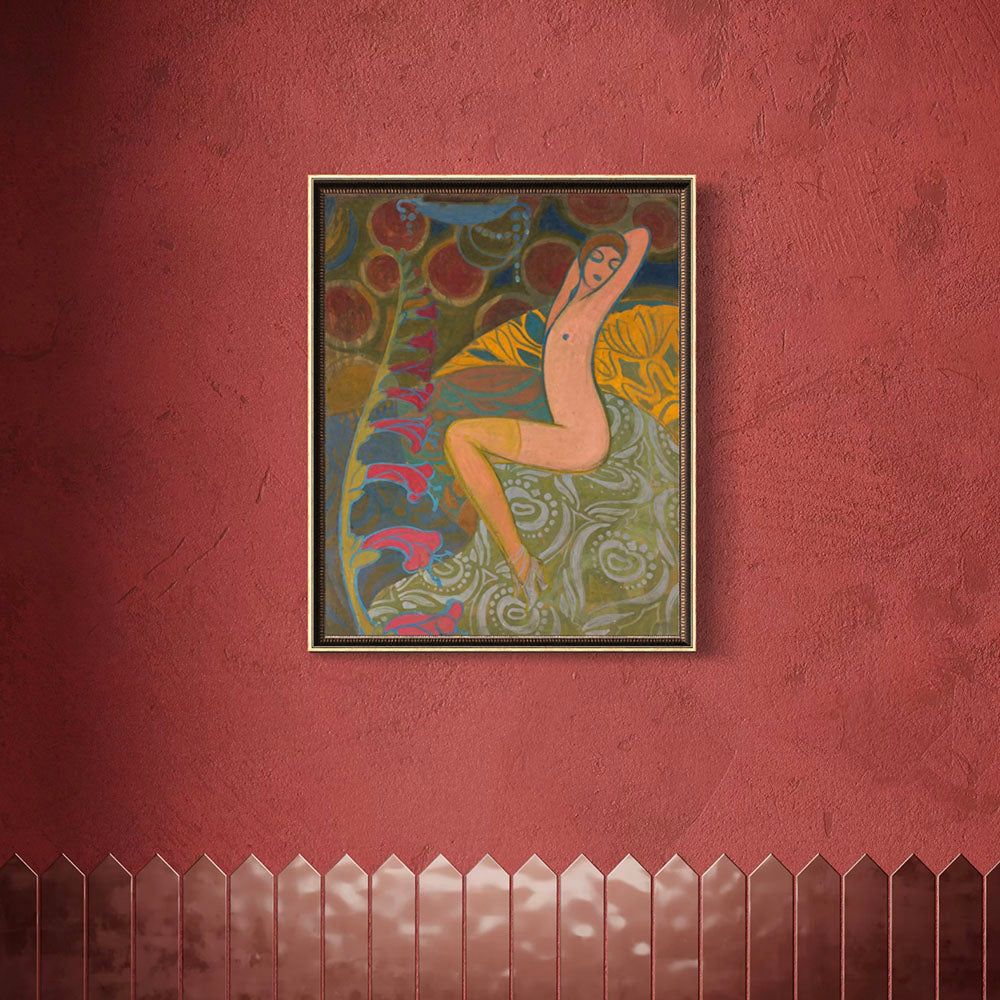
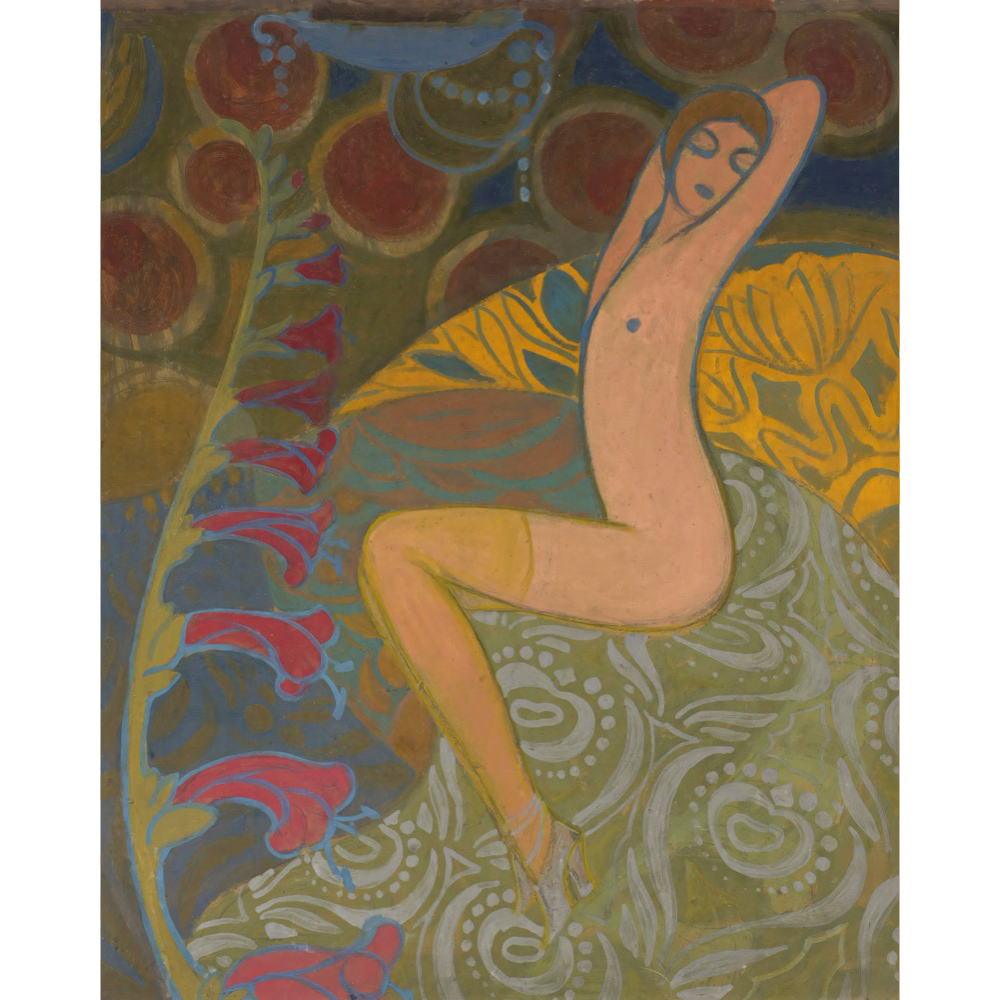
This vertical composition features a seated nude figure arched backward with arms raised behind her head, rendered in pale peach tones against a dense, patterned backdrop. To her left, a vertical stem bears a series of downward-facing,trumpet-shaped red and pink blossoms outlined in yellow and blue. The background consists of overlapping dark red and brown circular discs interspersed with blue patches, while the surface beneath the figure is decorated with white and grey swirling patterns and a large yellow floral motif on the right. The work utilizes a flattened perspective typical of early twentieth-century decorative illustration. It reflects the period's synthesis of organic botanical forms and stylized graphic pattern design.
Why We Picked It
The composition relies on a strong vertical axis established by the tall floral stalk on the left and the curving spine of the central figure. Lines are firmly delineated with visible outlines defining the figure, flowers, and background elements,separating flat zones of color. The tonal range is compressed, favoring saturated mid-tones, primarily ochres, olives,brick reds, and muted blues rather than deep chiaroscuro modeling. Color relationships pit warm peach and yellow tones against cool blues and muted greens. The patterning on the ground surface incorporates repeating white spirals and dotted circular borders, flattening the picture plane.
Notable Context
The early twentieth century saw a widespread integration of decorative arts and fine art, heavily influenced by the international Art Nouveau movement, Secessionist exhibitions in Central Europe, and the decorative ethos of the Wiener Werkstätte. Artists across Europe turned away from strict naturalism in favor of stylized linearity, flat color planes, and ornamental integration derived from nature. Botanical elements, stylized vines, and repeating geometric or circular motifs were standard vocabulary in graphic illustration and painting during the years leading up to the First World War. This visual culture emphasized surface pattern and graphic rhythm over illusionistic depth.
About the Artist or Publisher
The artist was a Polish painter, illustrator, and designer of Armenian ancestry who lived from 1886 to 1920. His formal training included studies at the Academy of Fine Arts in Munich, aligning his early output with contemporary European currents in illustration and decorative painting. His career was interrupted by military service during the First World War, in which he served as an officer in the Polish Legions before his death in combat in 1920. His surviving pictorial works frequently merge figurative subjects with decorative, linear patterning characteristic of the period.
Find a matching frame
-
Ornate Gold Frame — Baroque Rococo Deep Relief Gilded Picture Frame
Regular price $39.00 USDRegular price -
Verdant Press Frame — Rococo Victorian Deep Green Distressed Gold Picture Frame
Regular price $65.00 USDRegular price -
Baroque in Black and Gold Frame — Rococo Ornate Lacquer Picture Frame
Regular price $70.00 USDRegular price -
Classic Beveled Wood Frames – Square (12x12), Rectangular (12x16/16x20)
Regular price From $55.00 USDRegular price -
Old World Beauty Frame — Gothic Revival Baroque Ornate Vintage Picture Frame
Regular price $60.00 USDRegular price


