

Paris 1925 - Salle A Manger
Paris 1925 - Salle A Manger
Couldn't load pickup availability
About our restored prints
About our restored prints
Expertly restored: tears and stains are fixed, original clarity and depth of color are thoughtfully revived.
- Printed on museum-quality fine art paper
- Archival inks for long-lasting color
- Professionally color-calibrated
- Most framed prints ship unassembled for safety. Assembly is simple.
Shipping & Return Policy
Shipping & Return Policy
Classic Prints/Framed prints: 1-2 weeks
Frames & Decor: 2-3 weeks
Custom Frames: 2-3 weeks
Returns within 2 weeks.
Custom Framed prints are hand assembled and cannot be returned.
See policies in the footer
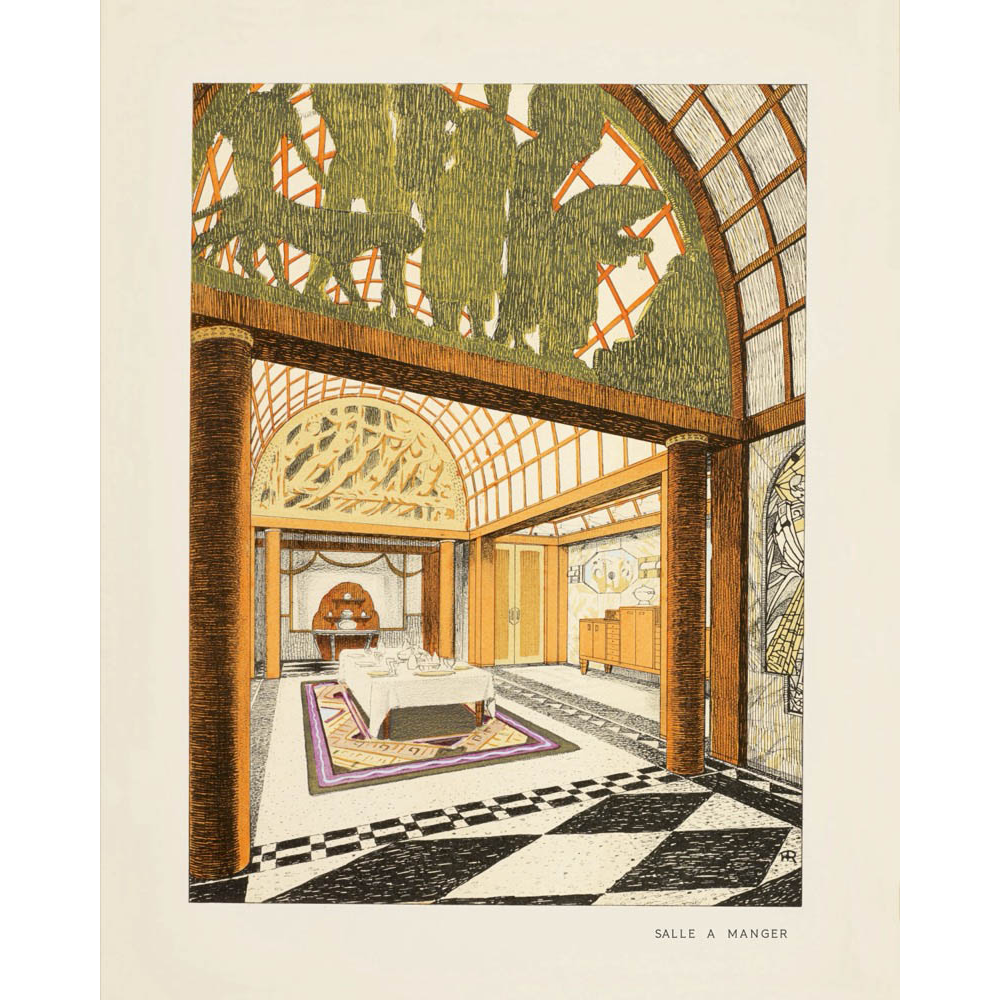
The Salle à Manger operates at the largest architectural scale of the five plates — a glass-roofed dining hall whose amber columns recede in forced perspective toward a luminous arched rear wall. The black-and-white diagonal checkerboard floor anchors the foreground with graphic intensity, while the canopy of stylized trees pressing against the glass roof above creates an atmosphere that is simultaneously monumental and organic. A lavender-bordered rug at center, a quiet chromatic interruption in an otherwise amber-and-black composition is the room's most unexpected detail, and one of the finest.
Why We Picked It
The forced perspective in this plate is exceptional. The eye travels from the bold diagonal floor geometry through the colonnade and into the luminous arch of the far wall, achieving a sense of spatial depth unusual for interior illustration of this period. The rendering shifts deliberately between sections: the floor is crisply geometric, the columns are heavily crosshatched and tactile, and the overhead foliage is rendered in loose, near-expressionistic marks. This contrast between precise geometry below and living organic matter above was a design argument, not a stylistic accident. The stained glass panel visible on the right wall adds a further chromatic layer, and the decorative relief of the rear arch confirms that every surface here was an intentional decision.
Notable Context
The winter garden dining room was a peak typology in French luxury interior design of the early 20th century — the integration of a glass conservatory with a formal dining space, functioning as both status gesture and sensory experience. By the 1920s, this format was being redesigned through an Art Deco lens: the organic controlled by geometry, the glass roof disciplined by a structural grid, the trees themselves abstracted into pattern. The checkerboard floor places this room squarely in the Art Deco vocabulary, while the tree canopy above acknowledges an older French tradition of bringing the exterior landscape into the interior dining experience. The resulting tension between those two impulses — graphic modernism and organic abundance — is what gives this plate its unusual energy.
Find a matching frame
-
Ornate Gold Frame — Baroque Rococo Deep Relief Gilded Picture Frame
Regular price $39.00 USDRegular priceUnit price per -
Verdant Press Frame — Rococo Victorian Deep Green Distressed Gold Picture Frame
Regular price $65.00 USDRegular priceUnit price per -
Baroque in Black and Gold Frame — Rococo Ornate Lacquer Picture Frame
Regular price $70.00 USDRegular priceUnit price per -
Classic Beveled Wood Frames – Square (12x12), Rectangular (12x16/16x20)
Regular price From $55.00 USDRegular priceUnit price per -
Old World Beauty Frame — Gothic Revival Baroque Ornate Vintage Picture Frame
Regular price $60.00 USDRegular priceUnit price per


