


Haifa — Vintage Middle Eastern Architecture & Port City Print
Haifa — Vintage Middle Eastern Architecture & Port City Print
Couldn't load pickup availability
About our restored prints
About our restored prints
Expertly restored: tears and stains are fixed, original clarity and depth of color are thoughtfully revived.
- Printed on museum-quality fine art paper
- Archival inks for long-lasting color
- Professionally color-calibrated
- Most framed prints ship unassembled for safety. Assembly is simple.
Shipping & Return Policy
Shipping & Return Policy
Classic Prints/Framed prints: 1-2 weeks
Frames & Decor: 2-3 weeks
Custom Frames: 2-3 weeks
Returns within 2 weeks.
Custom Framed prints are hand assembled and cannot be returned.
See policies in the footer
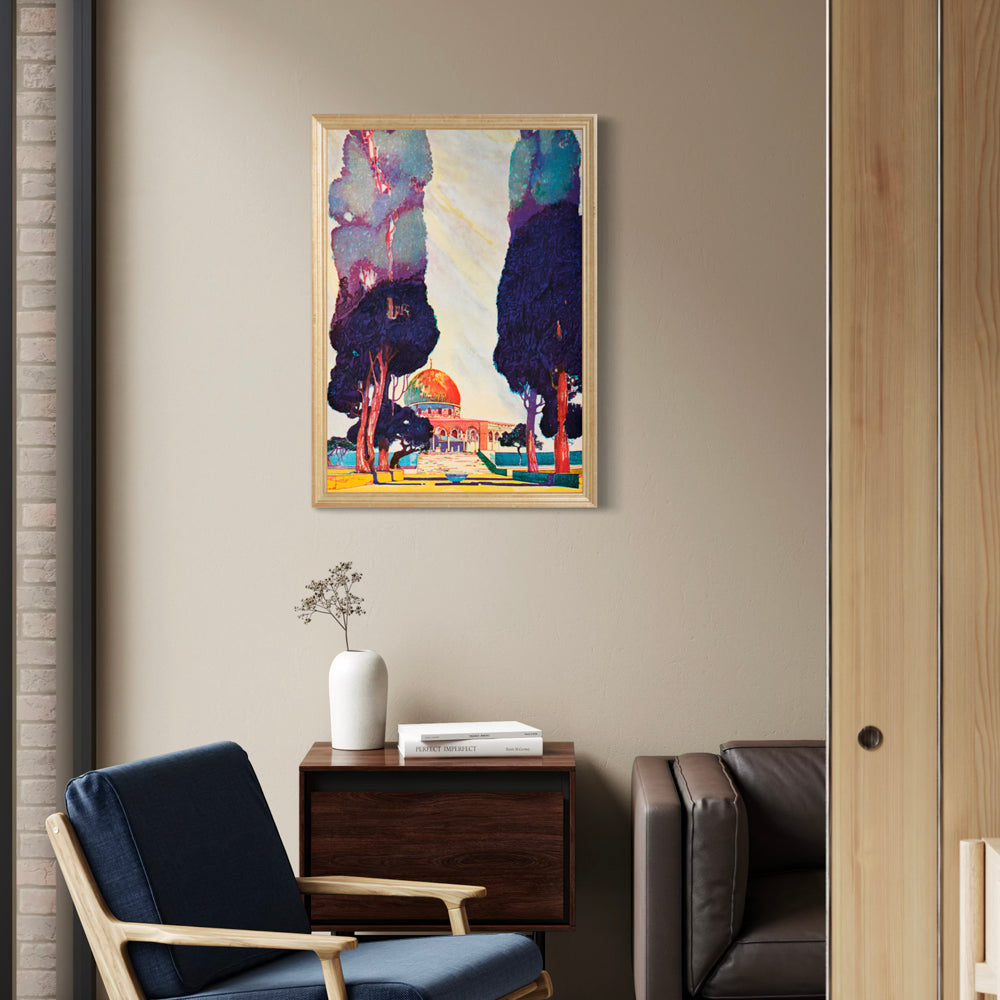
Art depicts Haifa in the early 20th century, a city undergoing rapid transformation under the British Mandate. The composition highlights the towering cypress trees leading toward the Shrine of the Báb, a focal point of the Bahá’í faith. The scene captures a moment of quiet grandeur, reflecting both Haifa’s spiritual significance and its emergence as a key port and cultural hub. The contrast of rich colors and strong architectural elements mirrors the city’s unique blend of history and progress.
Why We Picked It
The composition is striking in its balance between natural grandeur and architectural harmony. The towering trees, rendered in deep blues and purples, contrast with the luminous golden dome of the Shrine of the Báb, drawing the viewer’s eye along the stairway leading toward the sacred site. The interplay of light and shadow enhances the dreamlike quality. The use of bold contrasts—deep shadow against radiant sky, intense blues and purples juxtaposed with warm golds—imbues the image with a spiritual and historical significance of the city.
The artist’s technique brings an almost visionary clarity to the textures of the scene. The trees, their trunks streaked with red, seem to pulse with life, while the stairway leading to the shrine offers a sense of movement, drawing the viewer inward. There is a deliberate balance between nature and architecture, reinforcing Haifa’s role as a city where sacred spaces exist in harmony with the surrounding landscape.
Notable Context
This piece is part of a broader artistic movement that sought to document the landscapes and sacred sites of the Middle East during the early 20th century. Many European and local artists were drawn to Haifa’s unique blend of the ancient and the modern, capturing its evolution in works that combined realism with a touch of romanticism. The vibrant colors and expressive forms in this artwork reflect the influences of Orientalist painters, who sought to depict the mystique of the Holy Land while also conveying the region’s transformation under British rule.
In the 1920s, Haifa was emerging as a modern city under the British Mandate of Palestine. As one of the most significant ports in the region, it was experiencing rapid growth and industrialization, with new infrastructure reshaping its skyline. The completion of the Hejaz Railway’s branch to Haifa in the early 20th century had already established the city as a key transportation hub, linking it to Damascus and beyond.
Despite modernization, Haifa remained deeply tied to its religious and historical heritage. Mount Carmel, long associated with the prophet Elijah, continued to be a site of pilgrimage, while the Stella Maris Monastery, built on the mountain’s slopes, remained a key spiritual center for Christians. The Shrine of the Báb, seen in the painting, was completed in 1909 and had become the focal point of the Bahá’í faith, attracting visitors and pilgrims from around the world. The meticulously designed Bahá’í Gardens, though not yet in their current form, were already beginning to take shape as a place of tranquility and reflection.
Haifa in the 1920s was known for relatively peaceful coexistence among its Jewish, Christian, and Muslim residents. The 1920s saw the first signs of unrest between Jewish and Arab communities, foreshadowing the conflicts that would intensify in the coming decades.
About the location
Haifa's past is intertwined with maritime trade, religious devotion, and waves of migration that have shaped its character. From the sands of its shores, Tyrian purple, the fabled dye of antiquity, was once extracted. The city flourished under Ottoman rule, later becoming a strategic point during British Mandate Palestine. Today, it remains a symbol of coexistence, where modern industry meets ancient tradition, and where every street and stairway echoes with the footsteps of history.
Framed Prints Approx. Sizing
14"x20"
silver black metal frame Art 14.25x20 Interior 14.25x20 Exterior 14.375x20.125
antique silver wood frame Art 14.25x20 Interior 14.25x20 Exterior 15.375x21.125


Find a matching frame
-
Ornate Gold Frame — Baroque Rococo Deep Relief Gilded Picture Frame
Regular price $39.00 USDRegular priceUnit price per -
Verdant Press Frame — Rococo Victorian Deep Green Distressed Gold Picture Frame
Regular price $65.00 USDRegular priceUnit price per -
Baroque in Black and Gold Frame — Rococo Ornate Lacquer Picture Frame
Regular price $70.00 USDRegular priceUnit price per -
Classic Beveled Wood Frames – Square (12x12), Rectangular (12x16/16x20)
Regular price From $55.00 USDRegular priceUnit price per -
Old World Beauty Frame — Gothic Revival Baroque Ornate Vintage Picture Frame
Regular price $60.00 USDRegular priceUnit price per


