


Le Quatre Saisons — French Decorative Art Nouveau Print Four Seasons
Le Quatre Saisons — French Decorative Art Nouveau Print Four Seasons
Couldn't load pickup availability
About our restored prints
About our restored prints
Expertly restored: tears and stains are fixed, original clarity and depth of color are thoughtfully revived.
- Printed on museum-quality fine art paper
- Archival inks for long-lasting color
- Professionally color-calibrated
- Most framed prints ship unassembled for safety. Assembly is simple.
Shipping & Return Policy
Shipping & Return Policy
Classic Prints/Framed prints: 1-2 weeks
Frames & Decor: 2-3 weeks
Custom Frames: 2-3 weeks
Returns within 2 weeks.
Custom Framed prints are hand assembled and cannot be returned.
See policies in the footer
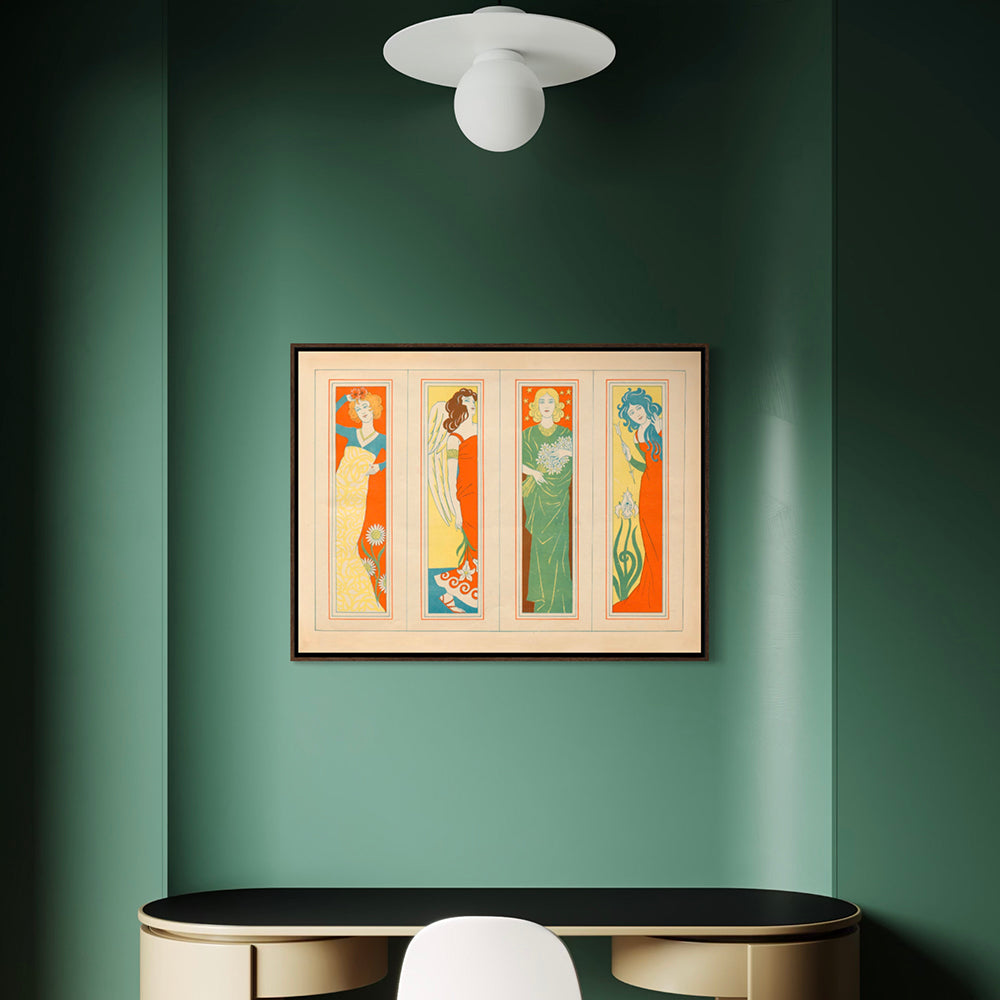
Intro Paragraph Four stylized female figures represent the natural cycle of the year within a clean four-panel composition. Rendered in a bold palette of teal, marigold, emerald, and vermilion, each figure commands a narrow, decoratively bordered frame. Fluid organic silhouettes, cascading tresses, and sinuous botanical motifs—such as daisies, lilies, and swirling vines—create a rhythmic visual cadence across the quadriptych.
Why We Picked It This composition showcases the graphic precision characteristic of late 19th-century decorative art. Rather than relying on traditional realistic shading, the image utilizes flat planes of saturated color outlined by crisp, dark contours reminiscent of cloisonnisme and Japanese woodblock prints (ukiyo-e). The rhythmic balance across all four vertical panels, paired with expressive linework in the drapery and botanical forms, yields an elevated decorative harmony suitable for curated print collections.
Notable Context Created around the turn of the 20th century, this piece directly reflects the Art Nouveau movement (Fin de Siècle Paris and Western Europe), which sought to erase the boundary between fine art and decorative design. Artists during this era responded to rapid industrialization by turning to natural, organic forms and classical allegories—frequently using the female form as a symbol for nature's cycles. The integration of graphic printing techniques (such as chromolithography) allowed high decorative art to enter everyday domestic interiors, aligning with the movement's goal of making art accessible within modern daily life.

Find a matching frame
-
Ornate Gold Frame — Baroque Rococo Deep Relief Gilded Picture Frame
Regular price $39.00 USDRegular priceUnit price per -
Verdant Press Frame — Rococo Victorian Deep Green Distressed Gold Picture Frame
Regular price $65.00 USDRegular priceUnit price per -
Baroque in Black and Gold Frame — Rococo Ornate Lacquer Picture Frame
Regular price $70.00 USDRegular priceUnit price per -
Classic Beveled Wood Frames – Square (12x12), Rectangular (12x16/16x20)
Regular price From $55.00 USDRegular priceUnit price per -
Old World Beauty Frame — Gothic Revival Baroque Ornate Vintage Picture Frame
Regular price $60.00 USDRegular priceUnit price per


