


Dancers Backstage — French Impressionist Ballet Art Print | 19th Century
Dancers Backstage — French Impressionist Ballet Art Print | 19th Century
Couldn't load pickup availability
About our restored prints
About our restored prints
Expertly restored: tears and stains are fixed, original clarity and depth of color are thoughtfully revived.
- Printed on museum-quality fine art paper
- Archival inks for long-lasting color
- Professionally color-calibrated
- Most framed prints ship unassembled for safety. Assembly is simple.
Shipping & Return Policy
Shipping & Return Policy
Classic Prints/Framed prints: 1-2 weeks
Frames & Decor: 2-3 weeks
Custom Frames: 2-3 weeks
Returns within 2 weeks.
Custom Framed prints are hand assembled and cannot be returned.
See policies in the footer
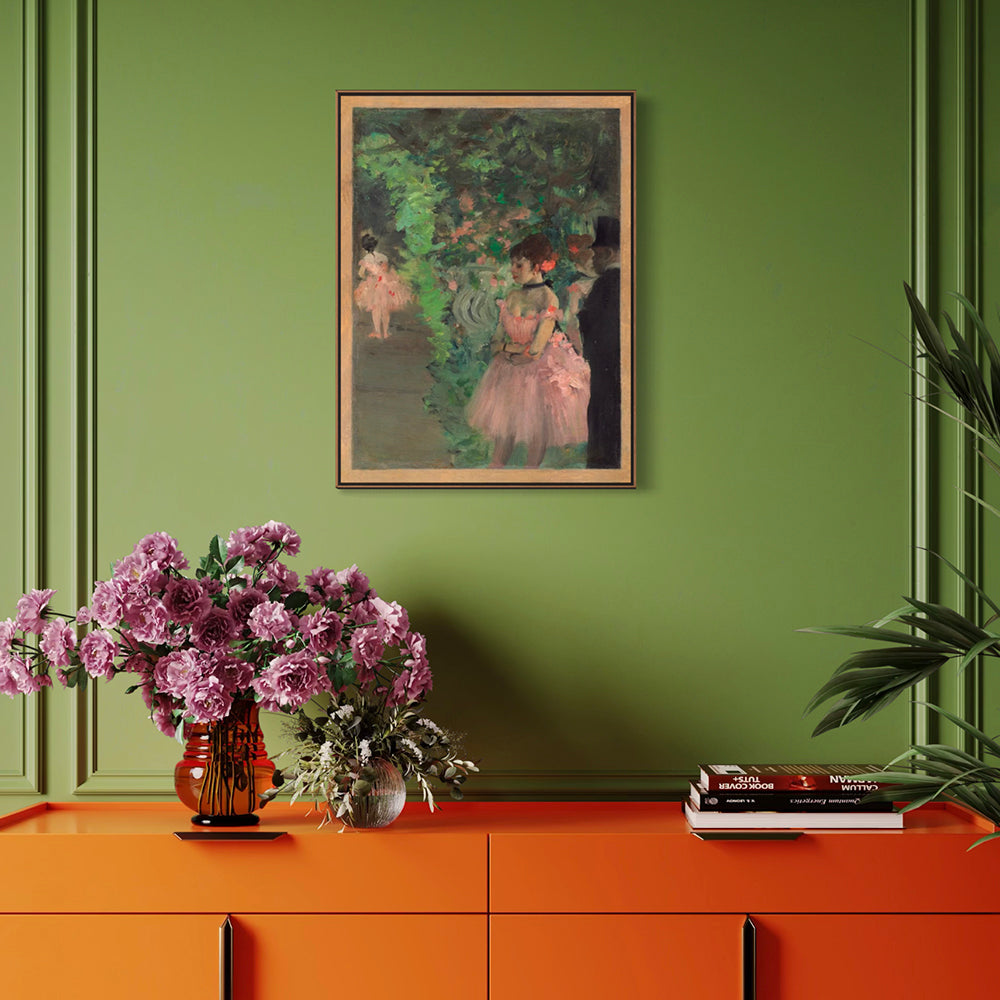
Three ballerinas in pink tutus stand backstage against dense, luminous green scenery. A man in a dark coat and top hat stands at the right edge, cut off by the frame. The framing places the viewer in the wings, recording an unguarded moment of theatrical preparation. Loose strokes of oil build a textured surface where bright pinks contrast with deep forest greens. This work reflects the late-19th-century fascination with the hidden world behind the Paris Opéra.
Why We Picked It
The composition is asymmetrical. A detailed foreground dancer anchors the right while a smaller dancer stands on the stage at the left. Short, overlapping strokes of green build the foliage into a textured backdrop. Tonal values shift sharply from the black silhouette of the man to the soft pink of the dancer's dress. Degas often cropped figures at the edge of the frame and chose unexpected viewpoints, and this picture shows both.
The National Gallery of Art reads the exchange between the man and the dancer beside him as the centre of the picture. Her lowered head and folded arms suggest indifference. The painting is small, at 24.2 by 18.8 cm. The museum says it may have been a sketch for a larger work, though none was made.
Notable Context
During the Third Republic, the Paris Opéra was a social hub for the wealthy bourgeoisie and the subscriber class known as the abonnés. These male patrons held backstage access, which created a world where young dancers interacted with wealthy benefactors. At the same time, painters were moving away from history and myth toward contemporary city life. Degas was friends with many of the dancers, singers and musicians he painted. The theater was a workplace as well as a place of entertainment.
About the Artist
Edgar Degas (1834 to 1917) never accepted the label Impressionist and preferred to call himself a Realist or an Independent. He showed little interest in painting outdoors and favored theaters and cafés lit by artificial light. Born into a wealthy banking family, he began by copying Italian Renaissance paintings at the Louvre and trained in the academic studio of Louis Lamothe, where line and draftsmanship came first. He painted dancers, laundresses and racehorses. From Japanese prints he took inventive compositions and points of view, and he was also influenced by photography. He was most drawn to informal moments, such as dancers backstage or at rest.
Styling Note
The palette is soft rose, deep green, black and sand, so it sits well on warm cream, sage or dark green walls. A black metal frame matches the man's suit and gives the picture its strongest edge. A gold frame warms the greens and suits a more traditional room. The 9x12 fits a hallway or the space above a dresser. The 12x16 gives the green backdrop enough room to read as a field of colour. Hung low, beside a chair or at the end of a stair, it keeps the viewer at the same eye level as the dancers.

Find a matching frame
-
Ornate Gold Frame — Baroque Rococo Deep Relief Gilded Picture Frame
Regular price $39.00 USDRegular price -
Verdant Press Frame — Rococo Victorian Deep Green Distressed Gold Picture Frame
Regular price $65.00 USDRegular price -
Baroque in Black and Gold Frame — Rococo Ornate Lacquer Picture Frame
Regular price $70.00 USDRegular price -
Classic Beveled Wood Frames – Square (12x12), Rectangular (12x16/16x20)
Regular price From $55.00 USDRegular price -
Old World Beauty Frame — Gothic Revival Baroque Ornate Vintage Picture Frame
Regular price $60.00 USDRegular price


