


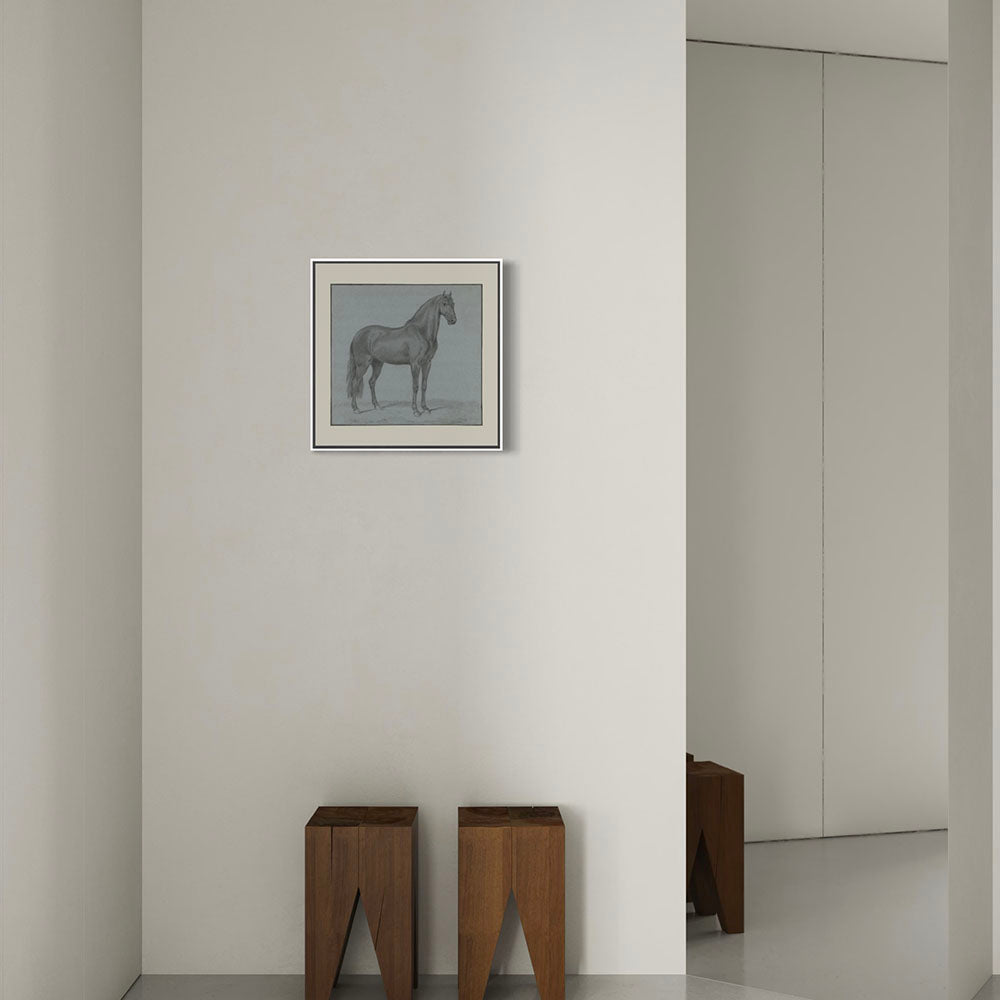
Equine Study in Blue — Vintage Horse Portrait Art Print
Equine Study in Blue — Vintage Horse Portrait Art Print
Couldn't load pickup availability
About our restored prints
About our restored prints
Expertly restored: tears and stains are fixed, original clarity and depth of color are thoughtfully revived.
- Printed on museum-quality fine art paper
- Archival inks for long-lasting color
- Professionally color-calibrated
- Most framed prints ship unassembled for safety. Assembly is simple.
Shipping & Return Policy
Shipping & Return Policy
Classic Prints/Framed prints: 1-2 weeks
Frames & Decor: 2-3 weeks
Custom Frames: 2-3 weeks
Returns within 2 weeks.
Custom Framed prints are hand assembled and cannot be returned.
See policies in the footer
This sensitive drawing presents a full-length portrait of a horse, belonging to Monsieur de Guille, rendered with a soft, observational grace. Executed on a distinct blue paper, the subject is defined by the subtle interplay of charcoal and chalk, creating a sense of quiet vitality. The viewer experiences a moment of stillness, as if catching the animal in a brief reprieve from its duties, characterized by an atmospheric depth that transcends a simple anatomical record
Why We Picked It
The drawing demonstrates the 18th-century technique of "heightening," where white chalk is applied strategically to represent light reflecting off the coat’s surface and the definition of the musculature. The artist avoids overworking the form, using black chalk for structural shadows and subtle touches of red chalk to suggest the vascular warmth of the muzzle and ears. This economy of means allows the blue paper to function as a third color, creating volume through tonal relationships rather than dense layering.
Notable Context
The late 18th century in the Netherlands was marked by the Dutch Enlightenment, a period that replaced Baroque allegory with empirical observation. This shift was fueled by a burgeoning interest in veterinary science and the publication of foundational anatomical texts, which demanded that artists move away from "rocking-horse" archetypes toward structural accuracy. Socially, the Dutch Republic was navigating the friction of the Batavian Revolution; amidst this instability, the landed gentry and figures like Monsieur de Guille used animal portraiture to document property and pedigree. These drawings functioned as a visual inventory of wealth and a testament to the owner's participation in the "Scientific Revolution," where the mastery of nature and the breeding of livestock were seen as vital to national progress and economic stability.
About the Artist or Publisher
Tethart Philipp Christian Haag (1737–1812) held the prestigious position of court painter to the House of Orange-Nassau. Beyond his individual commissions, he served as the director of the Hague Drawing Academy and was responsible for curating the princely collections of William V. His career was defined by a transition from the decorative demands of the court to the rigorous, observational standards of the early 19th century, making his work a primary record of the evolving Dutch aesthetic.


Find a matching frame
-
Ornate Gold Frame — Baroque Rococo Deep Relief Gilded Picture Frame
Regular price $39.00 USDRegular priceUnit price per -
Verdant Press Frame — Rococo Victorian Deep Green Distressed Gold Picture Frame
Regular price $65.00 USDRegular priceUnit price per -
Baroque in Black and Gold Frame — Rococo Ornate Lacquer Picture Frame
Regular price $70.00 USDRegular priceUnit price per -
Classic Beveled Wood Frames – Square (12x12), Rectangular (12x16/16x20)
Regular price From $55.00 USDRegular priceUnit price per -
Old World Beauty Frame — Gothic Revival Baroque Ornate Vintage Picture Frame
Regular price $60.00 USDRegular priceUnit price per


