


View In Tivoli 19th Century Roman Ruins Archway Print | Moody Vintage Landscape
View In Tivoli 19th Century Roman Ruins Archway Print | Moody Vintage Landscape
Couldn't load pickup availability
About our restored prints
About our restored prints
Expertly restored: tears and stains are fixed, original clarity and depth of color are thoughtfully revived.
- Printed on museum-quality fine art paper
- Archival inks for long-lasting color
- Professionally color-calibrated
- Most framed prints ship unassembled for safety. Assembly is simple.
Shipping & Return Policy
Shipping & Return Policy
Classic Prints/Framed prints: 1-2 weeks
Frames & Decor: 2-3 weeks
Custom Frames: 2-3 weeks
Returns within 2 weeks.
Custom Framed prints are hand assembled and cannot be returned.
See policies in the footer
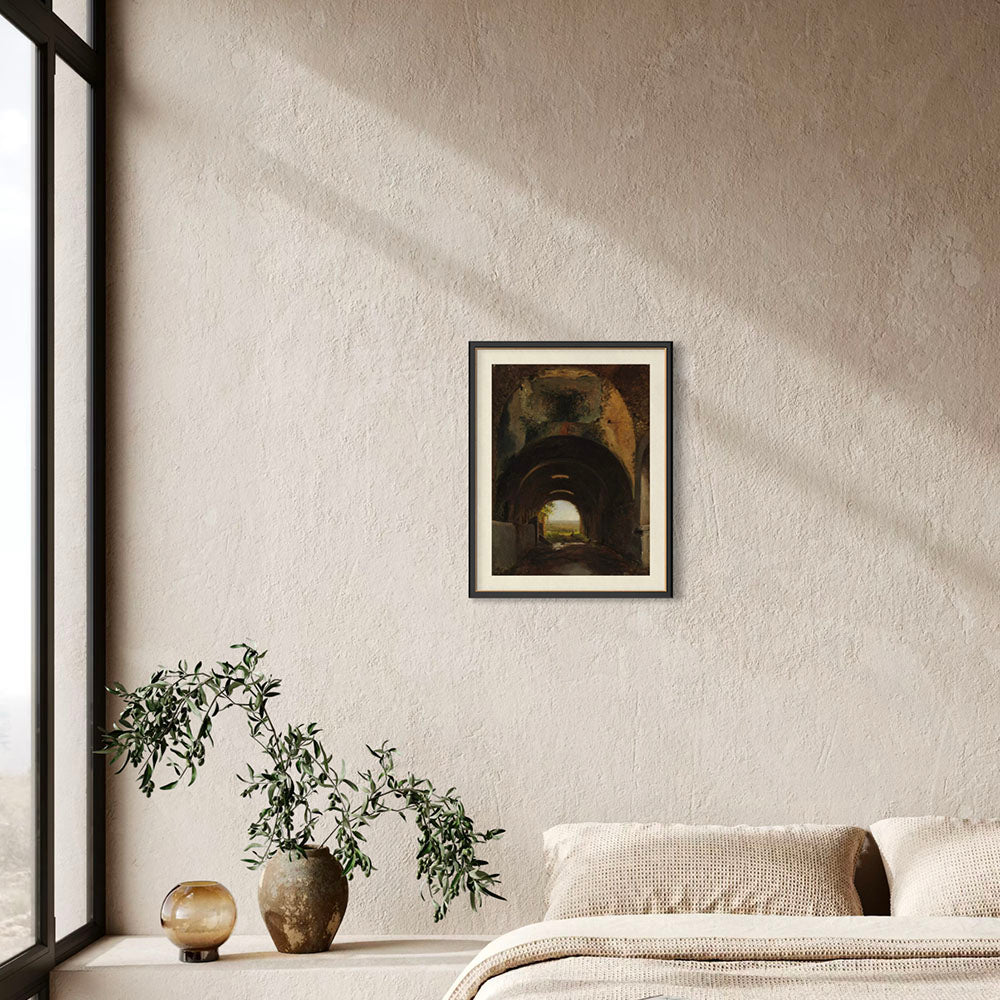
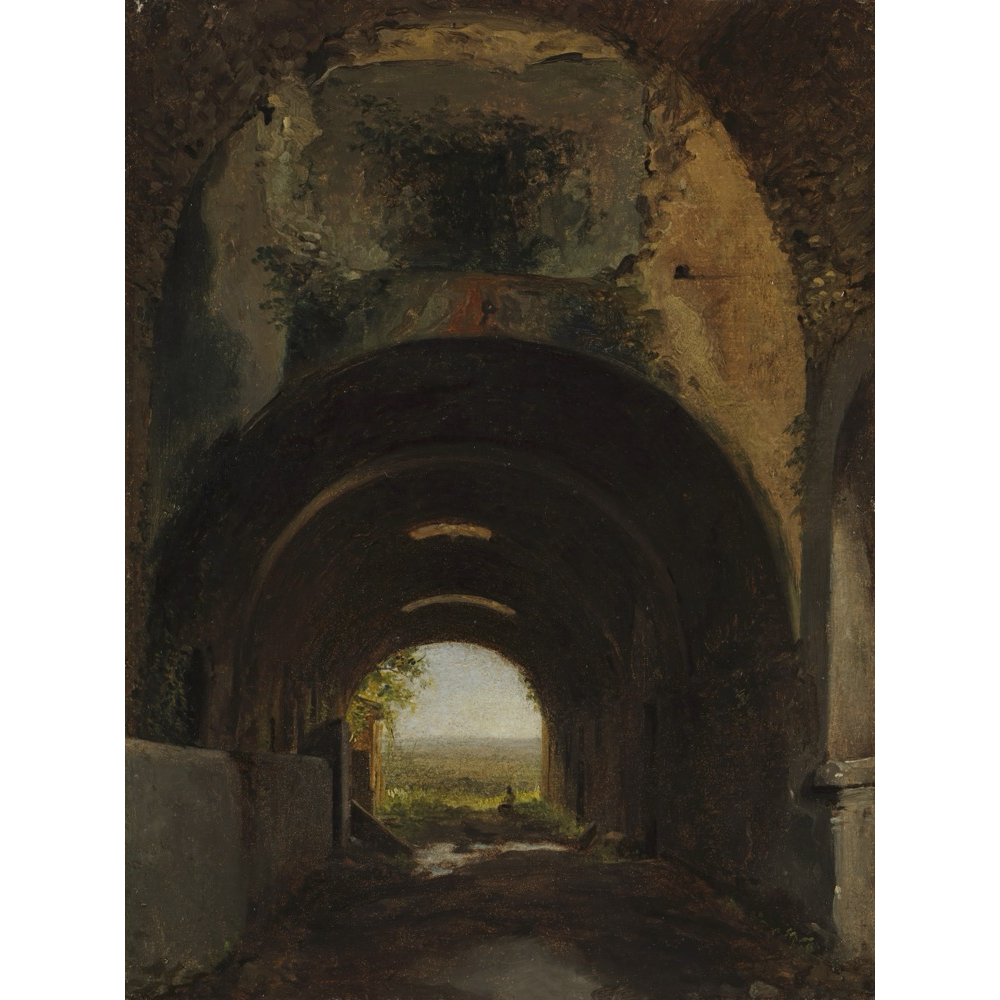
A towering, barrel-vaulted stone passage plunges into deep shadow, channeling the gaze toward a bright, sun-drenched opening overlooking the distant Italian countryside. Rainwater pools across the uneven earthen floor, reflecting the pale blue sky and golden light spilling through the far archway. Above, crumbling plaster, exposed brick, and tufts of wild greenery cling to the weathered masonry of the ancient Roman ruins. Painted around 1805–1810, this oil study captures the dramatic interplay between cavernous subterranean shadow and luminous Mediterranean daylight.
Why We Picked It
The composition acts as an architectural telescope, using concentric stone arches to create intense linear perspective and a powerful sense of depth. Rich, textured layers of burnt umber, warm terracotta, and weathered ochre convey the rough tactility of centuries-old masonry, contrasting with the smooth, luminous washes of sky and distant plain at the tunnel's end. Subtle light apertures pierced into the ceiling of the vault break up the darkness, guiding the eye steadily toward the solitary seated figure silhouetted against the sunlit threshold.
Notable Context
During the early 19th century, Tivoli—situated in the hills northeast of Rome—was an essential destination for French and European artists studying classical antiquity en plein air. The massive vaulted substructures of the Sanctuary of Hercules Victor, long misidentified in the 18th and 19th centuries as the "Stables of the Villa of Maecenas," fascinated Romantic painters for their sublime scale and dramatic light effects. Working directly on site with oil paint on paper or canvas, artists moved away from idealized neoclassical reconstructions to record the raw, atmospheric poetry of ruins reclaimed by nature.
About the Artist
François Marius Granet (1775–1849) was a French Neoclassical and early Romantic painter born in Aix-en-Provence, renowned for his atmospheric architectural interiors and plein air oil studies. After studying under Jacques-Louis David in Paris, Granet spent nearly two decades living and working in Rome, where he became a master of chiaroscuro lighting within vaulted churches, cloisters, and Roman ruins. His direct, painterly sensitivity to natural light and weathered surfaces deeply influenced the development of 19th-century French landscape painting.
Find a matching frame
-
Ornate Gold Frame — Baroque Rococo Deep Relief Gilded Picture Frame
Regular price $39.00 USDRegular price -
Verdant Press Frame — Rococo Victorian Deep Green Distressed Gold Picture Frame
Regular price $65.00 USDRegular price -
Baroque in Black and Gold Frame — Rococo Ornate Lacquer Picture Frame
Regular price $70.00 USDRegular price -
Classic Beveled Wood Frames – Square (12x12), Rectangular (12x16/16x20)
Regular price From $55.00 USDRegular price -
Old World Beauty Frame — Gothic Revival Baroque Ornate Vintage Picture Frame
Regular price $60.00 USDRegular price


